If you find the terms Artificial Intelligence, Machine Learning, and Deep Learning confusing, you’re not alone. They’re often used interchangeably, which can obscure how they connect to one another. This article aims to bring some clarity. Instead of a dry technical definition, we’ll explore five key takeaways that might surprise you. These takeaways will make the differences clear and show how these terms are connected.
It’s a Matryoshka Doll, Not a Team of Equals
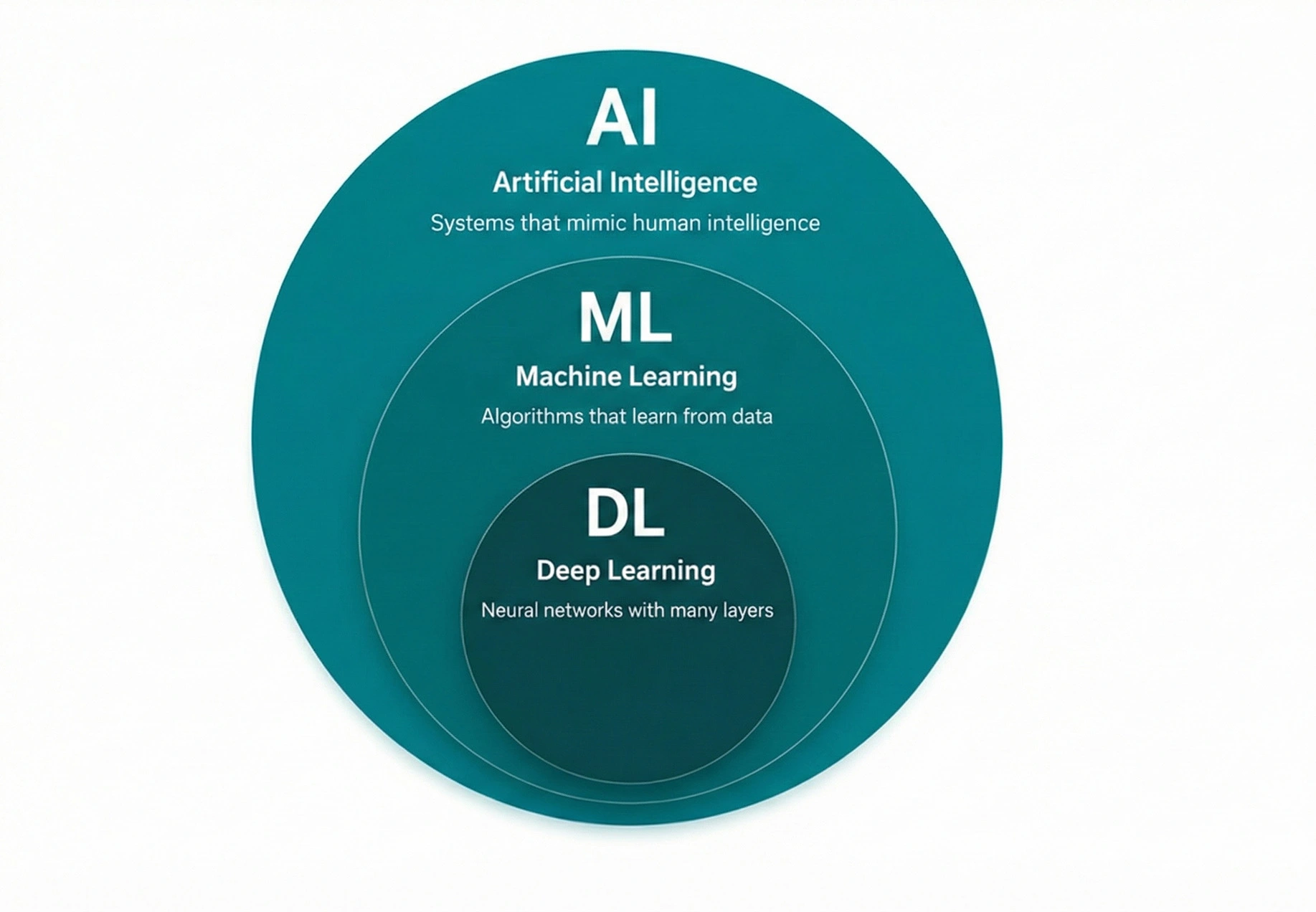
The most important concept to grasp is that these terms are not peers, they describe a hierarchy. AI is the broad, all-encompassing field, Machine Learning is a specific branch within AI, and Deep Learning is a specialized subfield within Machine Learning.
Here is a simple breakdown of the hierarchy:
- Artificial Intelligence (AI): The overarching concept of machines mimicking human intelligence.
- Machine Learning (ML): A subset of AI where machines learn from data.
- Deep Learning (DL): A specialized subset of ML using complex neural networks.
Intelligence Isn’t Always “Learning”
Early AI followed pre-programmed rules, while modern AI systems can actually learn from experience. This distinction marks a fundamental evolutionary leap.
A classic example of early AI is IBM’s Deep Blue, the chess-playing computer. It was programmed with an extensive library of possible moves and outcomes. However, it was "purely reactive" and could not learn on its own. To improve it, programmers had to manually add more features and possibilities.
In contrast, OpenAI Five, which competed against professional Dota 2 players, is a reinforcement learning system. Instead of being programmed with game rules, it learned by playing thousands of matches against itself. From these matches, it gradually improved, adjusting its internal parameters to discover effective tactics and coordination patterns that were never explicitly programmed. By the time it faced human teams, OpenAI Five could react in real time to complex game states and execute sophisticated team strategies that emerged purely from this training process.
The Biggest Difference is the Teacher
The core difference between standard machine learning and deep learning lies in the role of the human "teacher" and the level of intervention required for the system to learn.
Classic machine learning depends on a human expert to teach the model what to look for by performing "feature engineering." For example, to teach an ML model to identify pictures of a pizza, a burger, and a taco, a data scientist would first have to manually identify distinguishing features—like the shape of the bread or the presence of specific ingredients—and label the images accordingly.
Deep learning algorithms, on the other hand, can learn from their own mistakes through repetition without this direct human intervention. They automatically discover the relevant features from the data. AlphaGo, the program that mastered the complex game of Go, is a good example. Go is much more complex than chess, with 10 to the power of 170 possible board configurations. After initial training, AlphaGo improved by playing against different versions of itself thousands of times, refining its strategy after each match. This autonomous learning process is characteristic of deep learning.
It's All About the Data Appetite
The rise of deep learning is directly tied to the explosion of data. It's estimated that over 80% of an organization's data is unstructured - things like text, images, and audio. This massive volume of raw data is precisely the challenge that deep learning is uniquely equipped to handle. It can process images, text, and audio directly, while classic machine learning requires this data to be manually preprocessed first.
Machine learning and deep learning have vastly different requirements when it comes to the amount and type of data they need to function effectively.
“Deep” Literally Refers to the Layers in a Brain-Like Network
The term "deep" in deep learning isn't just a buzzword; it has a specific, literal meaning. It refers to the structure of the artificial neural networks that are the backbone of deep learning algorithms.
These networks are inspired by the human brain and are made up of layers of nodes: an input layer, one or more hidden layers, and an output layer. The "deep" in deep learning simply refers to the depth of these layers. A neural network is considered "deep" when it contains multiple hidden layers between the input and output layers. The more layers, the "deeper" the network.
Putting It All Together
Understanding the relationship between AI, Machine Learning, and Deep Learning is much simpler when you move past the interchangeable jargon. The "Matryoshka doll" analogy is the most effective way to remember their connection: AI is the largest doll, containing the smaller ML doll, which in turn contains the even smaller DL doll.