AI agents are specialized software systems that use artificial intelligence to autonomously achieve goals and complete tasks on behalf of users or other systems. However, the term encompasses a spectrum of capabilities: from tool-using assistants (LLMs with API access), through semi-autonomous agents that plan workflows but require approval for critical actions, to fully autonomous agents capable of independent decision-making over extended periods. While the latter remain rare in enterprise due to governance concerns, all AI agents share a common trait: they go beyond conversation into decision-making and problem-solving, adapting their actions as new information emerges during task execution.
The Anatomy of an AI Agent: Key Components
AI agents are built on an architecture that combines several key components to enable their advanced capabilities, from reasoning to real-world action.
- Foundation Model: At the core of an agent is a large language model (LLM) that serves as its reasoning engine, providing the agent's core language understanding and reasoning capabilities to interpret instructions and generate plans.
- Planning Module: This component allows the agent to break down complex goals into smaller, manageable steps and sequence them logically, enabling it to handle complex, multi-step tasks that differentiate it from simpler AI.
- Memory: Memory allows an agent to retain information across interactions. This includes short-term memory for immediate context (like chat history), long-term memory for historical data, episodic memory of past interactions, and even memory shared among multiple agents to maintain coherence and learn from experience.
- Tool Integration: Agents extend their capabilities by connecting to external software, APIs, databases, other agents, or even physical devices to perform real-world tasks like retrieving data, sending emails, running code, or controlling hardware.
The Logic of Autonomy: How AI Agents Work
AI agents operate autonomously through a cyclical loop, enabling them to think, plan, and act to achieve a specific goal. This loop typically consists of several phases:
- Observation & Reflection: The agent first analyzes the user's input and its current environment to understand the context.
- Planning: It breaks down the main goal into smaller, manageable tasks or steps.
- Decision Making: For each step, the agent decides which tool (e.g., web search, file system) to use.
- Execution: The agent generates the necessary parameters to trigger a tool, executes the action programmatically, and observes the result.
- Self-Correction: If an action fails or the result is insufficient, the agent updates its state and plan, looping back to try a different approach until the goal is met or a limit is reached.
AI Agents in Action: Industry Use Cases
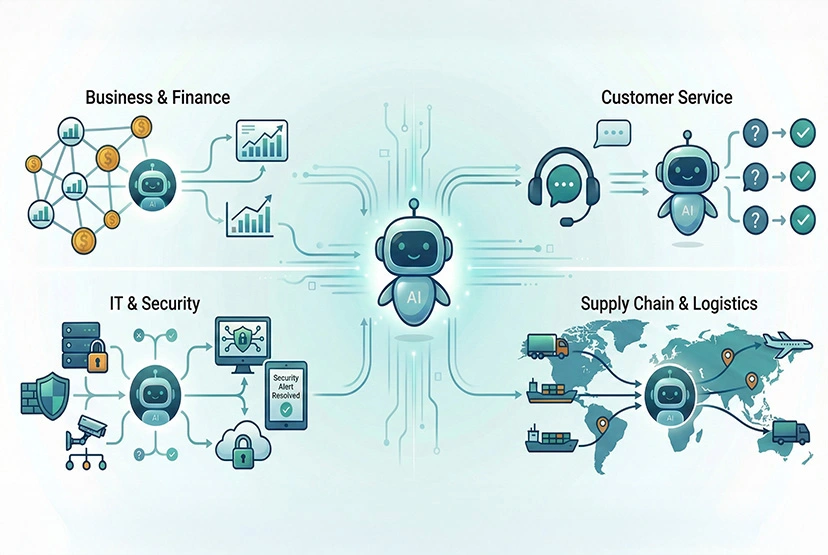
Customer Experience
Agents act as advanced virtual assistants integrated into websites and apps, delivering personalized support that anticipates user needs. They handle diverse tasks ranging from answering inquiries and resolving issues to simulating interviews and providing support, significantly enhancing user engagement.
Real-world example: Klarna's AI Assistant serves 85 million active users, performing work equivalent to 700 full-time employees. Built on LangGraph and LangSmith, the system automates ~70% of repetitive support tasks, handling everything from payments to refunds and escalations across 2.5 million conversations. The multi-agent architecture reduced average customer query resolution time by 80%, while simultaneously lowering operational costs and significantly decreasing customer escalations through improved root cause identification.
Banking and Financial Services
In finance, agentic AI performs continuous, autonomous risk audits to detect unusual patterns and respond to emerging threats. The technology is also well-positioned to assist with compliance monitoring and loan underwriting. On the customer-facing side, agents provide AI-driven financial advisory services, automating wealth management activities and crafting investment strategies based on market conditions.
Real-world example: mBank, one of Poland's leading digital banks, established an internal GenAI incubator to deploy AI agents across multiple operations. In their complaints department, AI agents analyze historical complaints, identify similar cases, and suggest proven solutions, resulting in a 15% reduction in average handling time. The agents support employees by analyzing whether responses are written in clear language, preparing ready recommendations, and learning from employee feedback on support quality. Additionally, mBank deployed agents to assist data analysts by translating natural language queries into SQL, significantly accelerating reporting and analysis across databases containing tens of thousands of tables.
Supply Chain Management
AI agents are particularly well-suited for supply chain and logistics due to their ability to act dynamically. They can streamline supplier selection, automate contracting and purchase ordering, and forecast demand based on market conditions. By cross-referencing these processes against inventory levels, they can prevent disruptions and identify opportunities to cut costs.
Real-world example: DHL, one of the world's largest logistics providers, implemented AI-powered solutions across its global warehouse and delivery network to optimize operations. The company deployed computer vision systems that automatically capture and analyze parcel images at high speed, detecting label information, barcodes, measuring dimensions, and assessing damage such as dents, tears, or leaks. These systems verify sorting accuracy and automatically direct packages to the correct chutes or bins in warehouse facilities. Additionally, DHL uses predictive analytics powered by AI to forecast potential disruptions by analyzing weather patterns, traffic conditions, and geopolitical events, enabling proactive route optimization and customer notifications. The implementation resulted in significant improvements in operational efficiency, reduced manual sorting errors, faster processing times, and enhanced ability to anticipate and mitigate delivery disruptions.
IT & Security
In the technology sector, code agents accelerate software development through AI-enabled code generation, while security agents strengthen organizational posture. These agents oversee the entire security lifecycle, prevention, detection, and response, to mitigate attacks and speed up investigations.
Real-world example: Claude Code is an advanced agentic coding assistant by Anthropic, demonstrating the practical application of AI agents in software development. Unlike traditional autocomplete tools, it functions as an autonomous agent capable of independently planning and executing complex programming tasks through multi-stage problem-solving. The newer version introduces sub-agent functionality, allowing for the delegation of specialized tasks such as planning, coding, testing, and code review. Claude Code proactively handles tasks, for instance, when asked to remove a hardcoded value in one file, it autonomously identifies and addresses similar instances across the entire project. This system has seen adoption in real-world business scenarios, contributing to Anthropic’s revenue growth.
The Value of Autonomy: Why Implement AI Agents
Deploying AI agents within enterprise structures delivers several key benefits that go beyond the capabilities of traditional chatbots or assistants:
- Increased Productivity and Operational Efficiency: AI agents can autonomously plan, reason, and execute complex tasks with minimal human intervention. Thanks to their ability to work on multiple tasks simultaneously (simultaneous execution), organizations can scale their operations, for example, in content production, without a proportional increase in headcount. This allows employees to delegate routine activities and focus on creative or mission-critical initiatives.
- Enhanced Decision Quality and Advanced Problem-Solving: Leveraging vast amounts of real-time data and predictive capabilities, agents support managers in making sounder strategic decisions. Multi-agent systems demonstrate particular power here, where specialized units collaborate, debate ideas, and fill gaps in each other's knowledge, leading to more precise outcomes and the synthesis of information from multiple sources. Agents can also utilize external tools and APIs, enabling them to solve problems that a language model alone cannot handle.
- Cost Reduction and Resource Optimization: Enterprises can significantly lower expenses by eliminating process inefficiencies and human error. For instance, in logistics, agents optimize delivery routes by balancing speed against fuel consumption, while in agriculture, they help increase crop yields and minimize waste through precise environmental monitoring.
Critical Considerations: Challenges and Limitations of AI Agents
While AI agents offer significant potential, organizations must navigate several critical challenges:
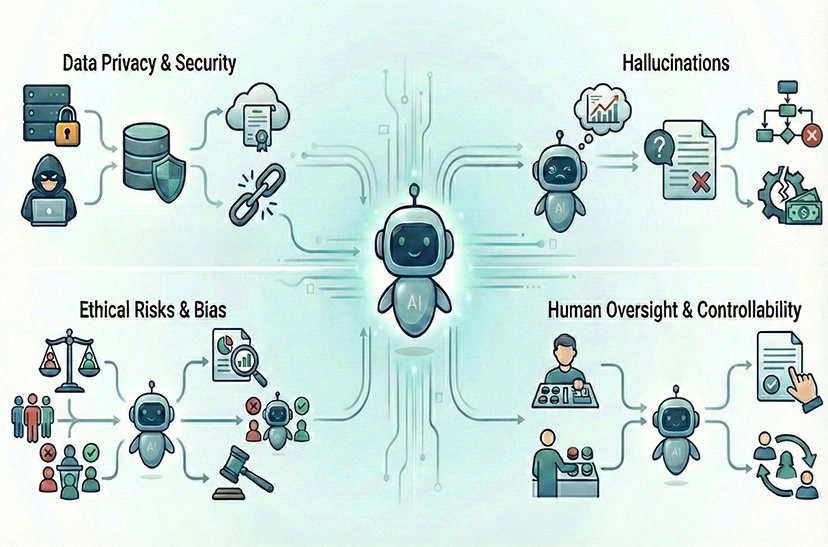
- Data Privacy & Security: AI agents require access to vast amounts of sensitive enterprise data to function effectively. Storing and processing this information raises significant privacy concerns and increases the risk of data breaches. Organizations must implement robust security postures to comply with strict regulations like GDPR or HIPAA and prevent unauthorized access.
- Hallucinations: One of the most significant challenges facing AI agents is their tendency to generate hallucinations, plausible-sounding but factually incorrect or fabricated information. An agent might execute decisions based on false data, leading to flawed business outcomes, incorrect customer responses, or costly operational errors. This challenge is amplified in multi-step workflows where an early hallucination can cascade through subsequent actions. Organizations must implement validation mechanisms, such as fact-checking layers or verification steps before critical actions, to mitigate these risks.
- Ethical Risks & Bias: Autonomous agents can inadvertently produce biased or inaccurate results, especially if their training data was of poor quality or lacked diversity. Without proper safeguards and human-in-the-loop oversight, there is a risk of unfair decision-making, particularly in sensitive areas like hiring or lending.
- Human Oversight and Controllability: While AI agents operate with high levels of autonomy, human oversight remains essential to ensure that their actions remain aligned with intended goals and standards. Feedback mechanisms involving a human-in-the-loop (HITL) are critical for improving the accuracy of responses and helping agents adapt to specific user preferences over time. In high-risk domains, it is a best practice to require human approval before an agent executes highly impactful actions, such as financial trading.
Conclusion
AI agents represent a pivotal shift in how businesses approach automation and problem-solving. By moving beyond simple text generation to autonomous reasoning, planning, and execution, they empower organizations to tackle complex workflows with unprecedented efficiency. From enhancing customer experiences and optimizing supply chains to strengthening security and transforming healthcare, the potential applications are vast. However, success lies not just in deployment, but in responsible management, addressing data privacy, mitigating bias, and navigating technical complexities. As this technology evolves, the organizations that balance innovation with robust governance will be best positioned to unlock the full transformative power of AI agents.