Image recognition is a field of artificial intelligence that enables computers to “see” and understand the content of images or video frames. It works by analyzing the pixels in an image, detecting characteristic patterns such as edges, shapes, and colors, and then using these patterns to recognize objects, people, text, or entire scenes. This allows a system to determine, for example, that an image contains a cat, a traffic sign, or a tumor in a medical scan, and assign appropriate labels or categories to what it sees.
How Image Recognition Works
Image recognition transforms raw pixels into meaningful predictions through a multi-stage process powered by machine learning algorithms. The journey begins when an image is converted into a machine-readable format by breaking it down into individual pixels, each represented by numerical values that capture color and intensity information.
These pixel arrays are then fed into deep learning models, typically convolutional neural networks (CNNs), which process the data through multiple layers to detect patterns, edges, shapes, and increasingly complex features at each stage. During training, these models learn from vast datasets of labeled images, adjusting their internal parameters to recognize specific objects, faces, or scenes with high accuracy.
Once trained, the model can analyze new images by comparing the detected features against the learned patterns and output predictions with confidence scores that indicate the likelihood of correct identification. This pixel-to-prediction pipeline enables computers to "see" and interpret visual data with speed and precision that often surpasses human capabilities, making image recognition a cornerstone technology in applications ranging from medical diagnosis to autonomous vehicles.
Primary Tasks of Image Recognition
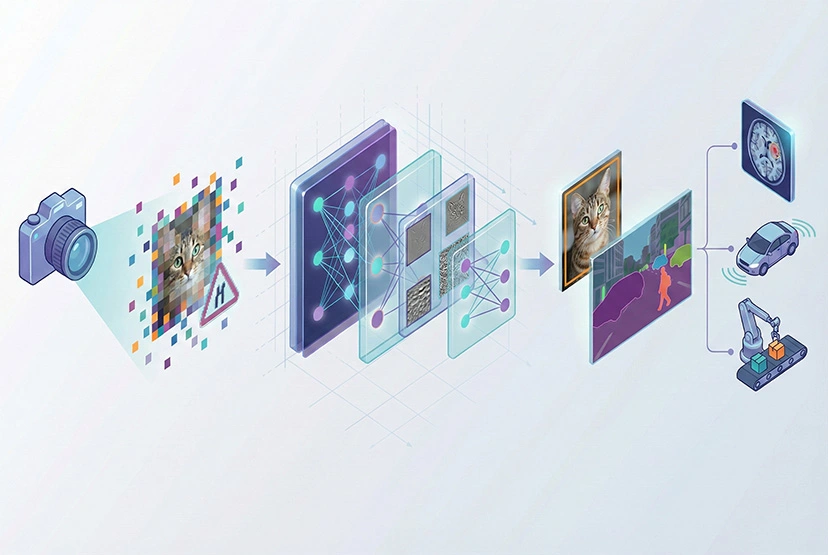
Image recognition systems perform several key functions that build upon one another to interpret visual data. While classification provides a high-level label for an entire image, other tasks like detection and segmentation offer more granular detail about the specific objects within that image.
- Classification: This is the task of assigning a single label to an entire image, such as identifying a photo as a "dog" or a "cat."
- Detection: This process involves locating and classifying one or more objects within an image, often by placing a bounding box around each identified object.
- Tagging: Similar to classification, tagging identifies multiple objects in a single image, allowing it to have more than one tag, such as 'vehicles,' 'trees,' and 'human.'
- Segmentation: This is a highly precise detection task that locates objects down to the nearest pixel using masks, identifying the exact pixels that belong to each object.
Key Technologies and Algorithms
Image recognition relies on several core technologies and algorithms. These include deep learning models such as convolutional neural networks, preprocessing and feature extraction techniques, and specialized architectures for different types of visual analysis tasks.
Convolutional Neural Networks
CNNs are the primary deep learning models used for image recognition, designed to process grid-like data such as images by sliding small filters over pixel arrays to detect local patterns, allowing the network to learn increasingly abstract features from edges and textures in early layers to complex objects in deeper layers.
Feature Extraction and Preprocessing
Before images are passed to a model, they undergo preprocessing steps such as resizing, normalization, and data augmentation (e.g., rotations, flips, noise addition) to improve robustness and generalization across different conditions and viewpoints. Feature extraction then identifies and isolates meaningful patterns within the image, such as edges, textures, shapes, and colors.
Transfer Learning and Pretrained Models
Many image recognition solutions build on pretrained models, which have been trained on massive datasets and then fine-tuned on a smaller, domain-specific dataset to adapt to a particular use case, reducing the amount of labeled data and compute required.
Real-World Applications of Image Recognition
Image recognition has become a foundational technology across many industries, automating tasks that previously required human visual inspection. It powers everything from everyday smartphone features to high-stakes systems in healthcare, transportation, and manufacturing.
Healthcare and Medical Imaging
- In radiology, image recognition helps analyze Xrays, CT scans, and MRIs to highlight anomalies such as tumors, fractures, or internal bleeding, supporting doctors in making earlier and more accurate diagnoses.
- In dermatology and ophthalmology, specialized models evaluate skin lesions or retinal scans, assisting clinicians in screening for diseases like melanoma or diabetic retinopathy at scale.
- Real-life example: IBM Watson Healthcare
Autonomous Vehicles and Smart Cities
- Self-driving cars rely on image recognition to detect lanes, pedestrians, traffic signs, and other vehicles, enabling realtime decisions about steering, braking, and acceleration.
- In smart city infrastructure, traffic cameras use recognition to track vehicle flow, detect congestion or accidents, and support adaptive traffic light control systems.
- Real-life example: Waymo – Self-Driving Cars
Manufacturing, Logistics, and Quality Control
- On production lines, high-speed cameras and recognition systems inspect products for defects such as cracks, misalignments, or missing components, improving quality control and reducing waste.
- In logistics and warehousing, image recognition is used for barcode-free package identification, pallet tracking, and automated inventory counting, increasing throughput and reducing manual scanning.
- Real-life example: Huawei Industrial AI-Powered Quality Inspection Solution
Workplace Safety and Occupational Health
- On construction sites and in industrial facilities, image recognition systems are used to detect missing personal protective equipment (PPE) such as helmets, vests, or gloves, triggering real-time alerts to prevent accidents.
- In hazardous environments, cameras analyze worker positions and movements to identify unsafe behaviors like entering restricted zones or operating machinery incorrectly, supporting proactive safety interventions.
- Real-life example: Safety Guard AI
Security, Authentication, and Content Moderation
- Facial recognition and object detection support access control, surveillance, and identity verification, for example in secure facilities or mobile device unlocking.
- On digital platforms, image recognition helps detect harmful, explicit, or copyrighted content at scale, allowing automated or semiautomated moderation of user-generated images and videos.
- Real-life example: Clearview AI
Document Processing and Optical Character Recognition (OCR)
- OCR systems extract text from scanned documents, invoices, receipts, and forms, enabling automated data entry and digitization of paper-based records for accounting, legal, and administrative workflows.
- In banking and finance, image recognition combined with OCR processes checks, identity documents, and contracts, accelerating verification procedures and reducing manual processing errors.
- Real-life example: Amazon Textract
Challenges and Limitations
Despite its remarkable capabilities, image recognition faces several technical, ethical, and operational challenges that can limit its effectiveness and raise concerns about its deployment. Understanding these limitations is crucial for responsible implementation and continued improvement of the technology.
Data Quality and Quantity Requirements
Image recognition models require massive amounts of high-quality labeled training data to achieve acceptable accuracy, and acquiring, cleaning, and annotating this data is time-consuming and expensive. Models trained on limited or biased datasets often struggle to generalize to new environments, lighting conditions, or object variations they haven't encountered during training, leading to performance degradation in real-world scenarios.
Bias and Fairness Issues
Image recognition systems can inherit and amplify biases present in their training data, leading to disparate performance across different demographic groups, particularly in facial recognition where studies have shown higher error rates for women and people of color. These biases can result in discriminatory outcomes in high-stakes applications like hiring, law enforcement, and access control, raising serious ethical and legal concerns about fairness and accountability.
Computational and Infrastructure Costs
Training state-of-the-art image recognition models demands significant computational resources, including specialized hardware like GPUs or TPUs, along with substantial energy consumption that can create environmental and financial barriers for smaller organizations. Even after deployment, running inference at scale requires ongoing infrastructure investments, particularly for real-time applications like autonomous vehicles or video surveillance that process continuous visual streams.
Adversarial Attacks and Security Vulnerabilities
Image recognition systems are vulnerable to adversarial attacks where small, often imperceptible alterations to an image can mislead the model into misclassifying objects. For example, adding perturbations to a stop sign can cause an autonomous vehicle's system to misclassify it as a speed limit sign, potentially leading to dangerous driving decisions. Researchers are developing countermeasures through techniques such as adversarial training, defensive distillation, and certified defenses that provide mathematical guarantees against specific attack types.
Privacy and Regulatory Concerns
Widespread deployment of facial recognition and image analysis raises significant privacy concerns, as individuals may be identified, tracked, or profiled without their knowledge or consent across public and private spaces. Regulatory frameworks like GDPR in Europe and various U.S. state laws impose restrictions on biometric data collection and processing, requiring organizations to navigate complex legal requirements and obtain explicit consent in many scenarios.
Conclusion
Image recognition is a core component of computer vision that allows machines to interpret the visual world. Driven primarily by the power of Convolutional Neural Networks, this technology is already transforming how we interact with data, automate tasks, and enhance our daily lives. As machine learning algorithms and computer vision capabilities continue to advance, more industries will implement image recognition to optimize their operations and deliver new and innovative value to their customers.