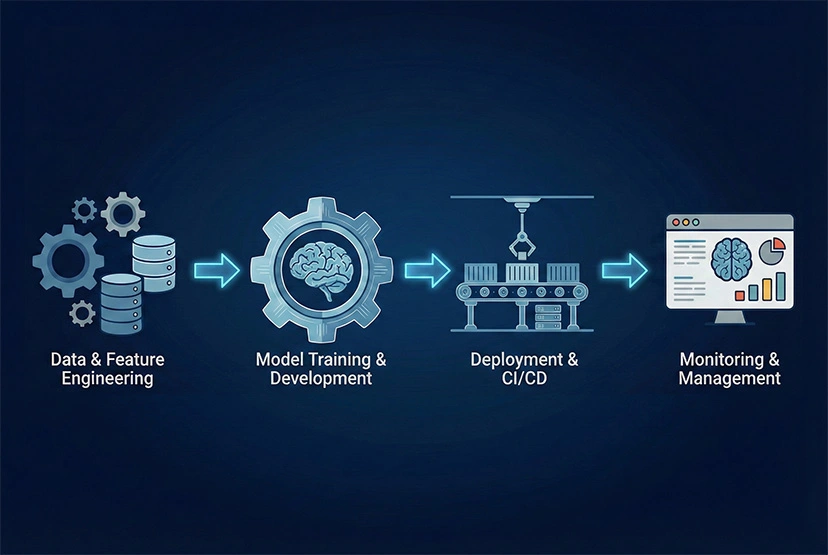
MLOps, short for Machine Learning Operations, is a set of practices that creates an assembly line for building, deploying, and running machine learning models. Its primary goal is to bridge the gap between ML model development and deployment, ensuring that models are built, tested, and released in a reliable and efficient way. MLOps unifies the work of data scientists, software engineers, DevOps engineers, and IT teams, automating and streamlining the entire model lifecycle.
Why Is MLOps Necessary?
Putting machine learning models into production is a difficult and complex process. Without a structured approach, organizations face significant hurdles that can slow innovation and introduce risk. The primary challenges that MLOps is designed to solve include:
- Complex Lifecycle: The path from data to a production model involves many intricate steps, including data ingest, data prep, model training, model tuning, model deployment, and model monitoring. Each stage requires careful management to ensure a successful outcome.
- Silos and Handoffs: The process demands collaboration across different teams, with handoffs from Data Engineering to Data Science to ML Engineering. Without a shared framework, this can lead to communication breakdowns and project delays.
- Risks of Manual Processes: Manual workflows are time-consuming and inefficient. They also introduce an increased risk of errors, lead to inconsistencies, and suffer from a lack of scalability as the number of models and datasets grows.
Core Benefits of Adopting MLOps
By implementing MLOps practices, organizations can directly address these challenges, gaining significant advantages:
- Increased Efficiency and Productivity: MLOps automates repetitive tasks such as data preparation, model training, and testing. This frees up teams to focus on higher-level activities like model development and innovation.
- Enhanced Scalability and Governance: MLOps establishes a defined and scalable process that enables reproducibility of ML pipelines. This allows organizations to effectively "oversee, control, manage, and monitor" thousands of models and reuse components across projects.
- Improved Model Accuracy and Performance: MLOps enables continuous monitoring, automated retraining, and systematic experimentation preventing model degradation.
- Faster Time to Market: By streamlining the entire ML lifecycle, MLOps enables businesses to deploy models more quickly, giving them a competitive edge.
- Improved Reliability and Risk Reduction: MLOps provides greater transparency and continuous monitoring, which helps to make quicker responses to issues like model drift.
- Reduced Costs: MLOps reduces expenses through optimization of computational resources, prevention of costly production failures, and elimination of manual overhead in the deployment and maintenance process.
MLOps in Practice
A typical MLOps pipeline automates and integrates several key stages, creating a repeatable and reliable workflow for managing machine learning models.
- Exploratory Data Analysis (EDA): This is the initial process of exploring, visualizing, and understanding the data to identify patterns and prepare it for the machine learning model.
- Data Prep and Feature Engineering: This critical step involves cleaning, transforming, and structuring raw data to create refined features that are more relevant and useful for model training.
- Model Training and Tuning: This is the process of using the prepared data to train an ML model and then optimizing its parameters to achieve the best performance.
- Model Review : In this phase, trained models undergo rigorous evaluation for accuracy, performance, and compliance with requirements before production deployment.
- Model Inference and Serving: This stage involves deploying a trained model into a production environment, making it available for applications and end-users to make predictions.
- Model Monitoring: This is the continuous tracking of a model's performance in production. It detects issues like model drift and also monitors data quality and infrastructure health and performance against metrics related to business.
- Automated Model Retraining: This is the process of setting up automated triggers to retrain a model with new data when its performance degrades or when fresh data becomes available.
MLOps vs. DevOps: What's the Difference?
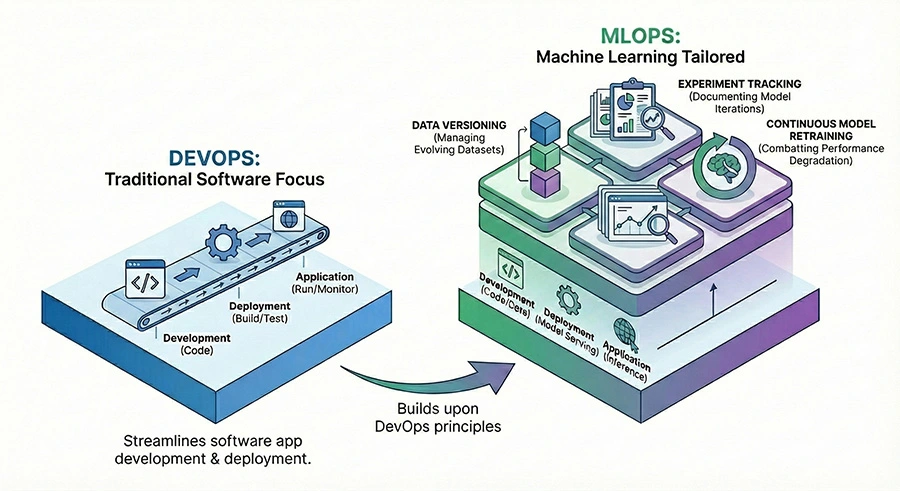
MLOps builds upon the principles of DevOps but is specifically tailored for the unique challenges of machine learning projects. While DevOps focuses on streamlining the development and deployment of traditional software applications, MLOps addresses additional layers of complexity unique to machine learning. These challenges include data versioning to manage evolving datasets, experiment tracking to document model iterations, and continuous model retraining to combat performance degradation.
Conclusion: Making Machine Learning Work at Scale
MLOps transforms machine learning from experimental projects into reliable, production-grade systems that deliver consistent business value. By establishing standardized processes and automated workflows, organizations can scale their ML capabilities while maintaining model quality and compliance. The investment in MLOps practices pays dividends through faster deployment cycles, reduced operational costs, and improved model performance over time. As machine learning becomes increasingly central to business operations, adopting MLOps is no longer optional - it's essential for organizations that want to compete effectively and deploy AI responsibly at scale.