This article explains what cycle time in manufacturing is and how to measure it, including at manual workstations.
What is cycle time in manufacturing
Cycle time in manufacturing is the time it takes to complete one unit of a process at a station, from the start of the work until the station is ready to start the next unit. The Lean Enterprise Institute defines it as a value timed by actual measurement, so a standard time from an ERP system isn't cycle time.
Two variants matter on the shop floor. Machine cycle time is the time a machine needs to complete all of its operations on one piece. Operator cycle time is the time an operator needs to complete all the work elements at a station before repeating them, timed by direct observation. At a manual workstation, the operator's work is the cycle, so operator cycle time is what you measure.
Cycle time describes one process or one station. The time a product needs to move through the whole plant is lead time.
How to calculate cycle time: formula and example
To calculate cycle time in manufacturing, divide net production time by the number of units produced:
Cycle time = net production time ÷ units produced
Net production time is the time the station was scheduled to work, without planned breaks and planned downtime. Take an illustrative example: a station works 7 hours net, which is 25,200 seconds, and completes 420 units. The average cycle time is 60 seconds.
Some guides add waiting and transport time to the formula. That brings the number closer to lead time and makes stations harder to compare. In this article, cycle time covers only the work at the station, in line with the definition above.
The formula gives you an average. An average of 60 seconds can hide most cycles at 56 seconds and an occasional cycle at 70 seconds or more. Seeing that requires timing individual cycles, not dividing totals.
Cycle time vs. takt time vs. lead time
Cycle time is often confused with takt time and lead time. The three answer different questions.
In a simple example, a plant that works 480 minutes a day, with customer demand of 240 units a day, has a takt time of 2 minutes. If a station's cycle time is longer than takt time, that station can't keep up with demand.
The three also sit on one scale: the time that actually adds value is usually shorter than cycle time, and cycle time is shorter than production lead time.
Why measure cycle time
Several everyday decisions depend on knowing cycle time:
- Keeping pace with demand. Comparing cycle time with takt time shows whether a station can deliver what customers order.
- Finding the bottleneck. The station with the longest cycle time sets the output of the whole line.
- Planning and quoting. Capacity plans, staffing, and cost estimates all start from how long a unit takes.
- Choosing what to improve. Cycle time reduction starts with the step that takes the longest or varies the most.
For cycle time reduction, the measurement decides where to start. A step that looked slow in one short study may have hit a single bad cycle, while a step that varies a lot may not show up in a short sample at all.
Historical examples of cycle time
In April 1913, Ford split the assembly of a flywheel magneto at its Highland Park plant into 29 steps, each done by a different worker along a line. According to Plant Engineering, the time to assemble one magneto fell from 20 minutes to five. Ford then moved the whole chassis along a line, and by 1914 the time required to assemble a Model T had dropped from 12 hours and 30 minutes to 93 minutes. That is the time for the whole car, not the cycle time of a single station on the line.
Takt came from elsewhere. It was first used as a production management tool in the German aircraft industry in the 1930s, as the interval at which aircraft moved to the next station. Toyota used it widely in the 1950s, and by the late 1960s it had spread throughout Toyota's supplier base.
In lean practice today, operator cycle times are still timed with a stopwatch on a time observation form and compared with takt time on an operator loading chart.
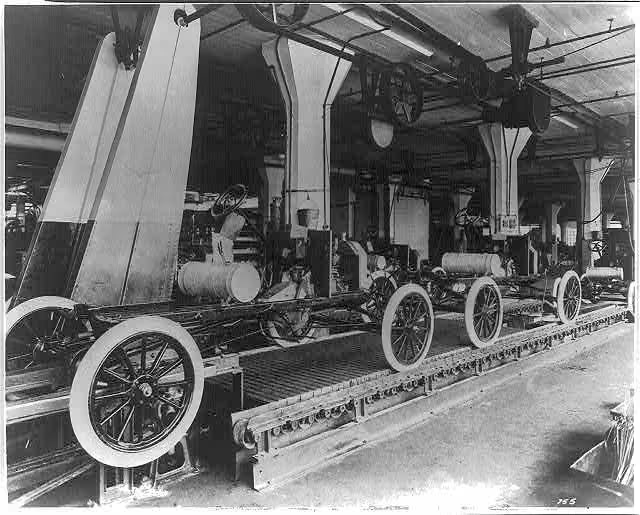
Ford Assembly Line at Highland Park Plant, before 1920.
How to measure cycle time
Before measuring anything, define the event that starts a cycle and the event that ends it. As Velaction's guide to the time observation sheet notes, the point that starts a cycle is the same one that ends the previous cycle. Steps within the cycle need the same kind of clear boundaries.
There are multiple ways to measure cycle time:
Manual workstations often have no machine signal at all. That leaves a stopwatch, a recording someone has to watch, or a camera.
Measuring cycle time at a manual workstation with computer vision
Measuring cycle time with computer vision means using a camera over the station and an AI model that recognizes the parts, the tools, and the operator's hands in every frame. Process logic marks the start and end of each step and each cycle, and the system records their times without any input from the operator.
The measurement runs in real time. It can also run after the fact on recorded footage, including recordings made before the system was installed, as long as the camera saw the steps from the same position. Reports can cover any past period, and the recordings themselves don't have to be stored, because the reports are built from the saved results.
Compared with the methods above, the camera times every cycle instead of a sample, and every step within it. That shows how cycle time varies between cycles, operators, and shifts, and which step varies the most. In the illustrative example below, the average is 60 seconds, but two of the eight cycles took 68 and 74 seconds, and in both the extra time comes from fastening.
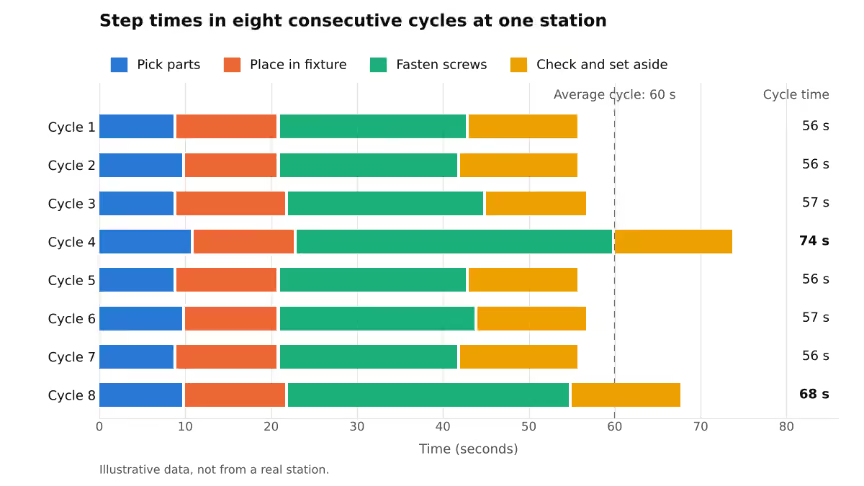
Illustrative example: step times in eight consecutive cycles at one station. The average is 60 seconds, but it hides two slow cycles, and the extra time sits in one step.
The same recordings feed other station metrics, which we cover in our article on error proofing manual assembly with computer vision.
This works under a few conditions. Every step has to be visible to the camera, and the camera position and lighting have to stay the same. The start and end of a cycle also have to show in the image, for example the moment a finished unit is set aside. The AI model is trained on recordings of that specific station, so every change to the process means retraining it and updating the logic.
Researchers at the University of Alberta described how such a system is built in a 2025 conference paper. Their AI model detects parts and tools, and the logic recognizes each step from the objects that appear together in the frame. The time of a step runs from the first to the last frame in which it was recognized. Across 11 recordings of products in different configurations, the measured cycle time ranged from about 34 to about 257 seconds. The authors also describe a pitfall: one tool was often confused with other objects, which inflated the time of the step that depended on it. Linking that step to a second object improved its detection.
A peer-reviewed study from the University of Wisconsin-Madison reports a system that times each assembly step and the whole cycle in real time, and also flags skipped steps and steps done out of order.
Getting started
The simplest way to find out whether a camera can measure cycle time at your plant is a proof of concept on one station with a simple process. At Codya, that's where Manual Assembly Monitoring, our computer vision service for manual workstations, starts: a proof of concept on one station, built on footage of your actual process. Because the system also works on past recordings, footage you already have can be the starting point, if the camera sees every step.
Know your average cycle time, but not which step stretches it? Tell us about it. From the first recording of your station, we'll be able to tell whether its cycle and step times can be measured with computer vision.
FAQ
Should cycle time include waiting time?
Not the waiting between processes, which belongs to lead time. Waiting inside the cycle, such as an operator standing by a machine, is part of operator cycle time and is worth tracking as its own step.
How many cycles should you time?
With a stopwatch, typical time observation sheets call for 6 to 10 cycles. More cycles give a better picture of variation. A camera times every cycle, so the question becomes which period to look at.
Does the operator have to do anything when a camera measures cycle time?
No. There is no button to press or code to scan. The system recognizes the start and end of each step from the image.
Can cycle time be measured from past recordings?
Yes, including footage recorded before the system was installed, as long as the camera saw every step from the same position. Reports can cover any period those recordings span.
Can one camera measure cycle time for a whole line?
It depends on the layout. One camera can cover a few neighboring stations if every step is clearly visible. Longer lines usually need more cameras.
Is cycle time the same as takt time or lead time?
No. Cycle time is measured at one station. Takt time is calculated from available time and customer demand, and lead time is how long a product takes to move through the whole process, including waiting between stations.
How do you reduce cycle time in manufacturing?
Start with the step that takes the longest or varies the most, not with the average. Find out why it varies, change one thing at a time, and measure again to confirm the change worked.