Automated PPE Compliance Monitoring


Workplace safety regulations, including ISO 45001 occupational health and safety management requirements, demand that manufacturers maintain consistent, verifiable oversight of PPE compliance. In practice, this is rarely achievable. Safety managers cannot monitor every feed simultaneously, violations go unrecorded, and when incidents occur, the evidence needed for formal reporting is often incomplete or unavailable.
Unlike conventional software development, many components of this project had no off-the-shelf solutions. Each architectural decision demanded research, prototyping, and validation.

Turning Existing Cameras into a Safety Inspection System
Our approach was simple in principle: understand the operational environment first, then build around it. In practice, that meant months of deliberate engineering, balancing detection accuracy, inference speed, and infrastructure cost to deliver a system that safety teams could actually depend on.
We technically refined the project's objectives, translating real-world workplace safety needs into precise engineering specifications and acceptance criteria.
Our team researched and fine-tuned the optimal AI model, GPU infrastructure, and runtime configuration, evaluating trade-offs between cost, speed, and detection quality.
We conducted performance testing and pursued targeted improvements to maximize frame processing throughput and reduce latency.
Over several months, we built the complete solution, from the GPU-accelerated backend to a responsive frontend, integrating all core monitoring and reporting features.
We released the application to a production environment, ensuring operational stability, traffic security via Cloudflare, and reliable performance under real industrial conditions.
We technically refined the project's objectives, translating real-world workplace safety needs into precise engineering specifications and acceptance criteria.
Our team researched and fine-tuned the optimal AI model, GPU infrastructure, and runtime configuration, evaluating trade-offs between cost, speed, and detection quality.
Over several months, we built the complete solution, from the GPU-accelerated backend to a responsive frontend, integrating all core monitoring and reporting features.
We conducted performance testing and pursued targeted improvements to maximize frame processing throughput and reduce latency.
We released the application to a production environment, ensuring operational stability, traffic security via Cloudflare, and reliable performance under real industrial conditions.
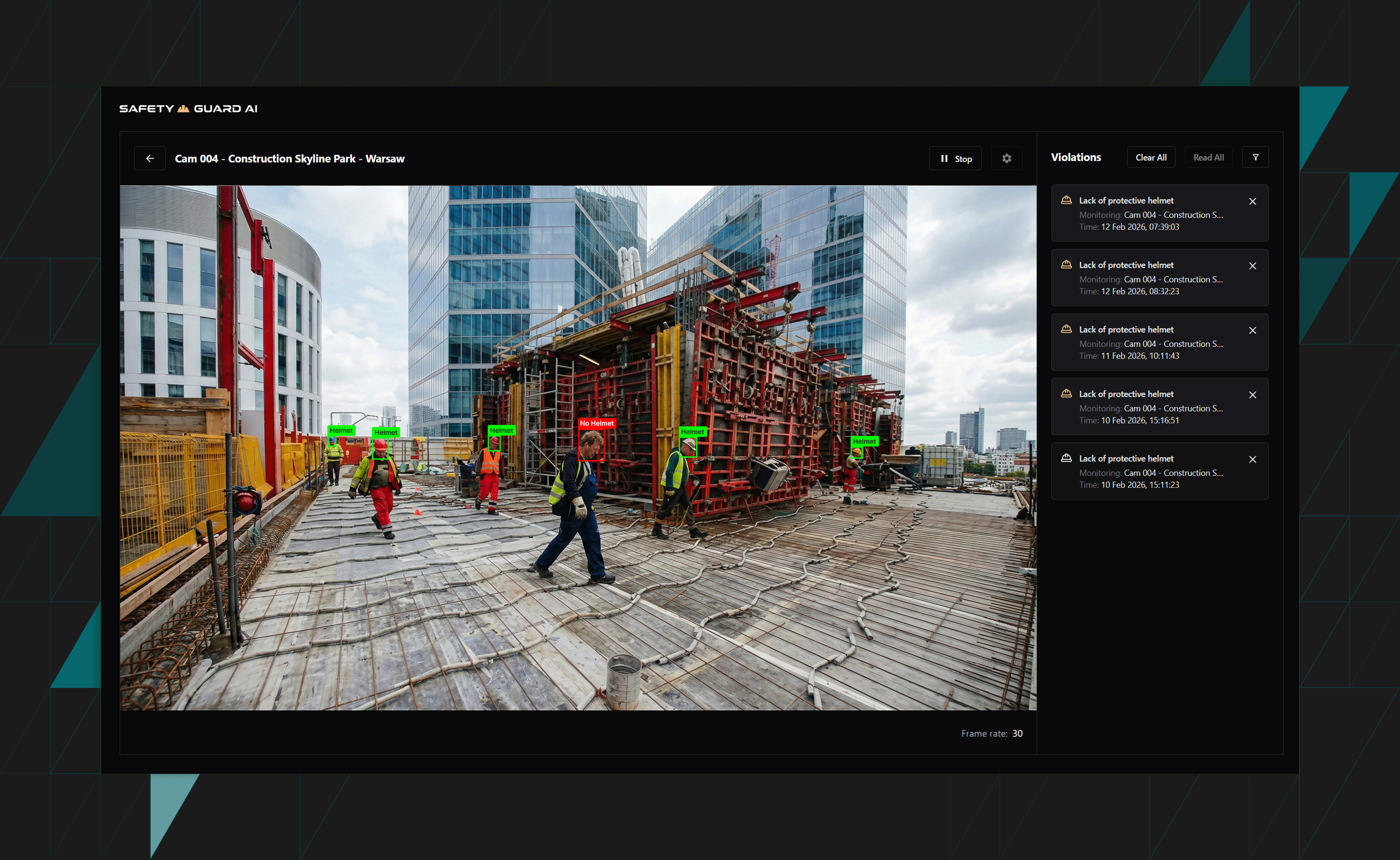
Real-Time Monitoring
The system processes live video streams from industrial cameras, instantly identifying PPE violations, such as workers without hard hats, and surfacing them in a live application dashboard with visual confirmation.
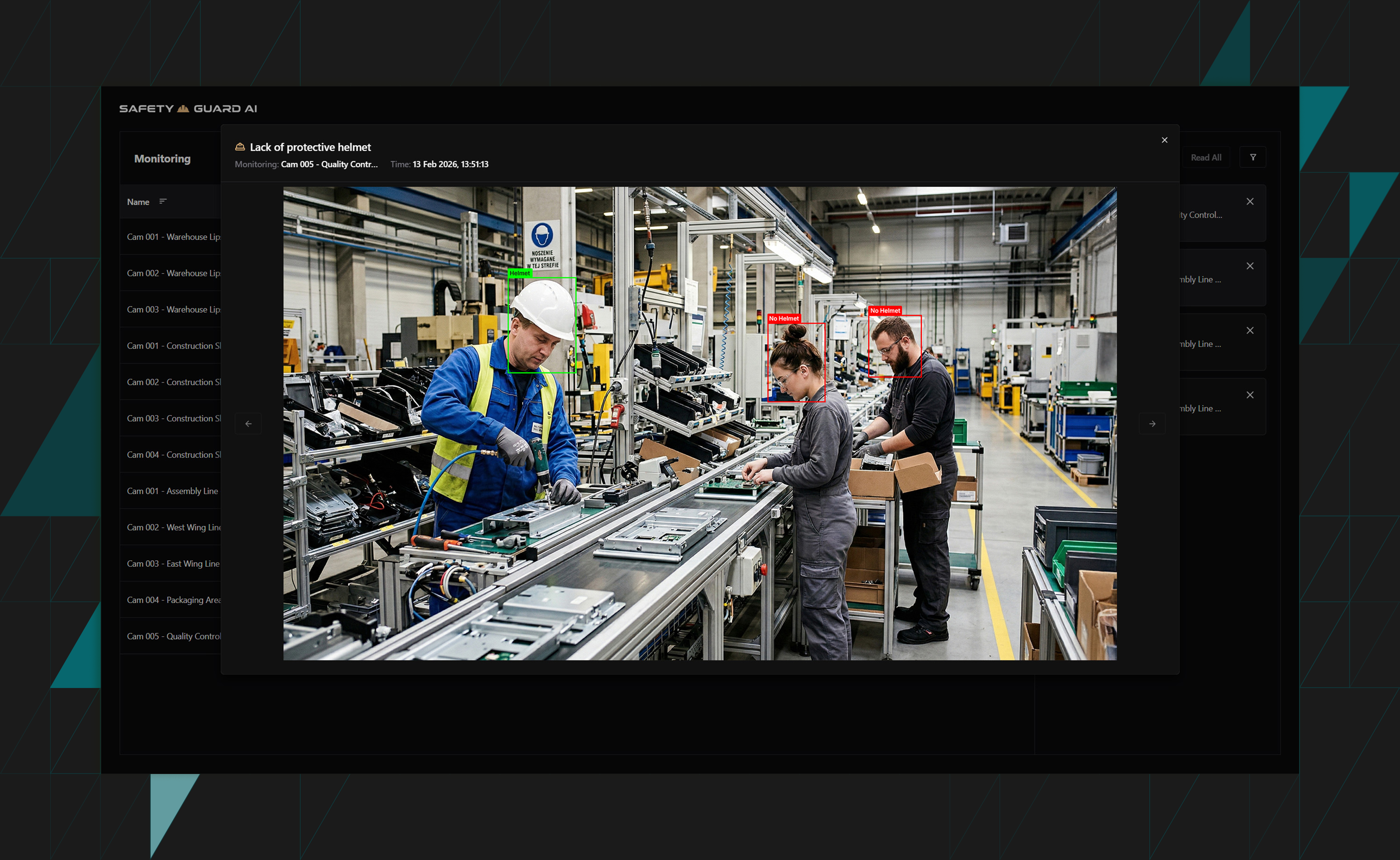
Detailed Violation View
Each event can be reviewed in full, including violation type, camera name, date, duration, and the associated visual material.
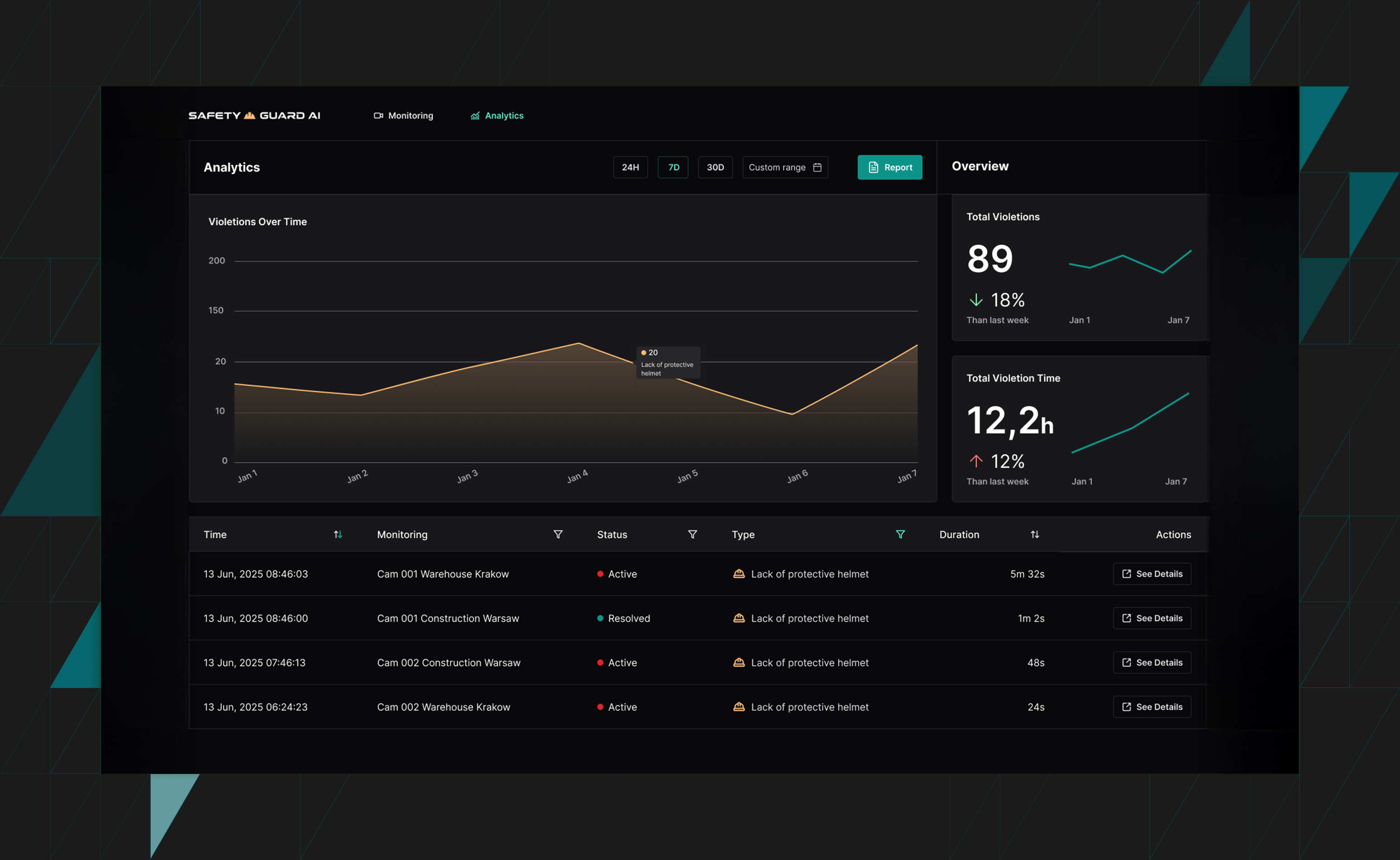
Analytics Dashboard
Violation counts, both aggregate and over time, alongside duration metrics are surfaced through intuitive trend visualizations, giving safety teams actionable insight into recurring risk patterns and progress over time.
Safety Guard AI demonstrates that industrial video analytics doesn't require replacing existing infrastructure; it enhances it. By deploying a custom-trained detection model on cloud GPU hardware and wrapping it in an intuitive safety inspection software interface, we delivered a solution that makes automated visual inspection and PPE compliance monitoring practical for any manufacturing environment.
per stream for fluid motion analysis
feeds processed simultaneously on a single GPU instance
detection accuracy achieved by the fine-tuned RF-DETR model
single-image inference latency
per stream for fluid motion analysis
single-image inference latency
feeds processed simultaneously on a single GPU instance
detection accuracy achieved by the fine-tuned RF-DETR model


At Codya, we work side-by-side with you, bringing technical know-how, honest advice, and a partnership built on trust.