Poka-yoke exists to stop a small error from turning into an expensive one. This guide covers the types of poka-yoke in manufacturing, the devices plants use to put them into practice, and where classic mistake-proofing stops working.
What is Poka-yoke?
Poka-yoke (Japanese for "mistake-proofing") is any mechanism that stops an error from happening or catches it right away, so a defect never moves down the line. The concept was developed by Shigeo Shingo as part of the Toyota Production System.
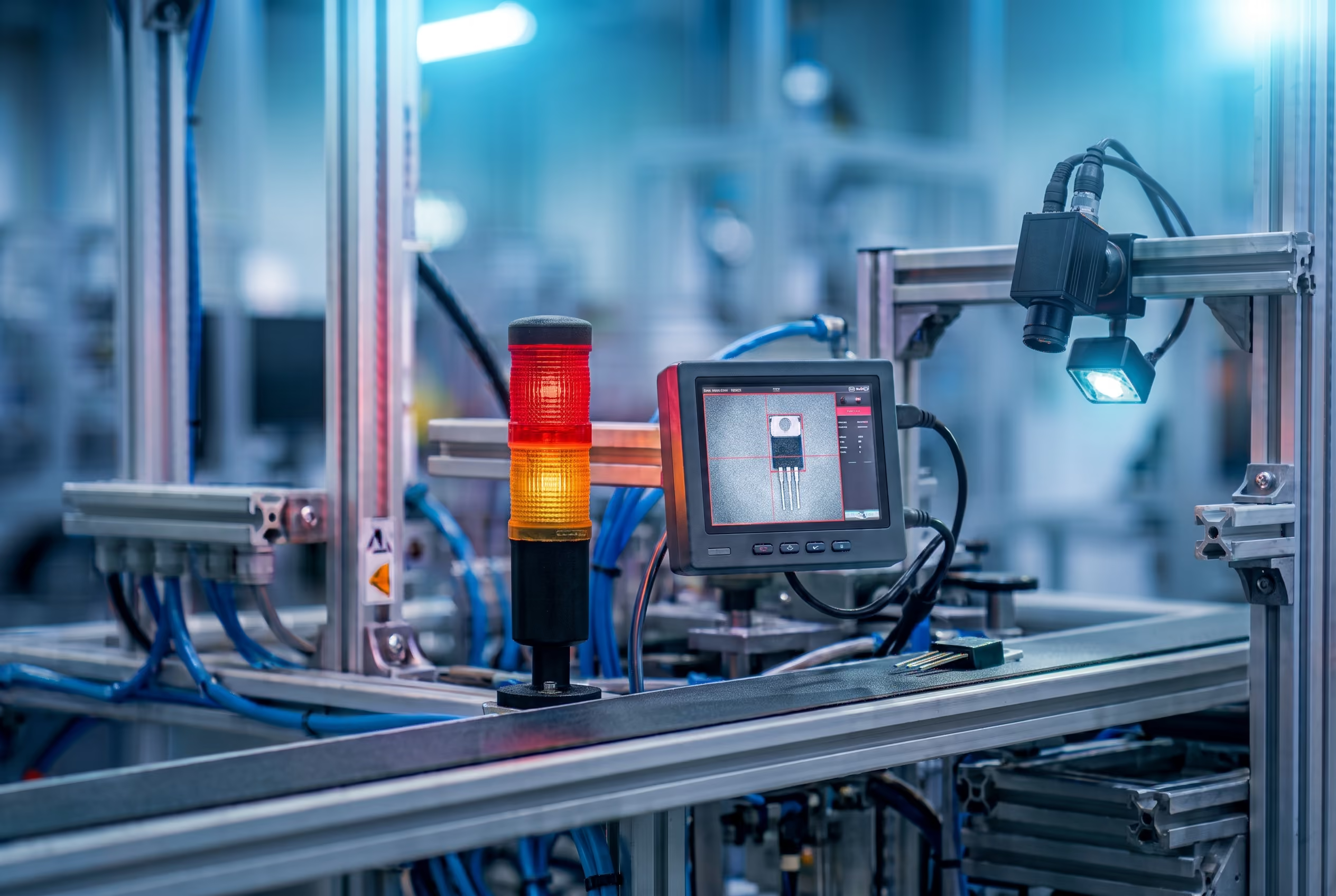
The idea behind it is simple: people make mistakes, and training alone won't stop them. So instead of asking operators to be more careful, you design the process so the mistake either can't happen or can't go unnoticed.
You’ve used poka-yoke even if you’ve never heard the term. A SIM card has one cut corner, so it can’t go into the tray the wrong way. A USB-A plug fits only one way, even if finding it usually takes three tries.
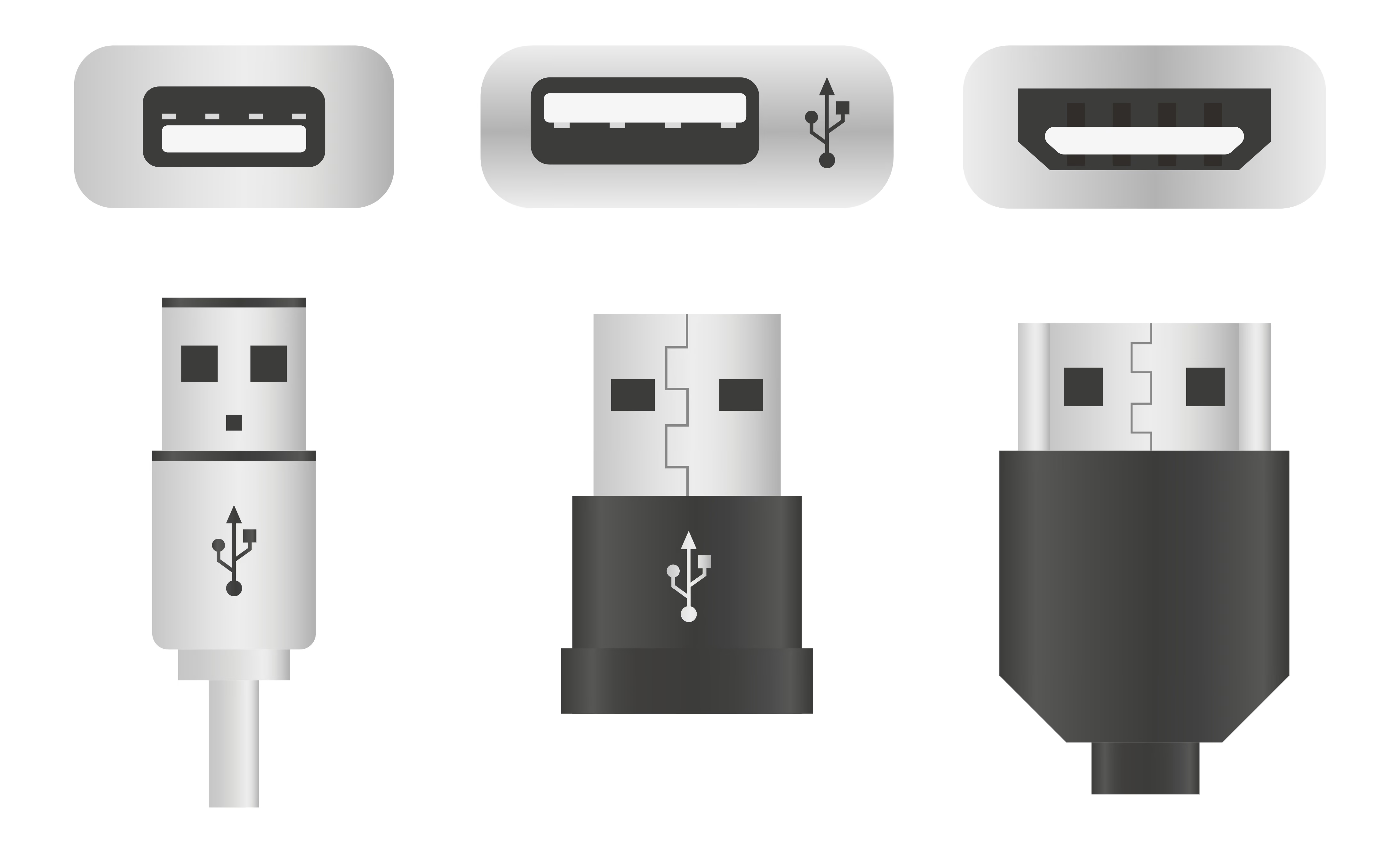
https://lepszymanager.pl/wp-content/uploads/2020/10/poka-yoke-usb-port.svg
Poka-yoke and error proofing mean the same thing. Some plants use the Japanese term, others the English one.
Types of poka-yoke
There are two ways to sort poka-yoke: by what it does when an error occurs, and by how it detects the error.
By function: control vs. warning
- Control (prevention) poka-yoke makes the error physically impossible. The part won't fit the wrong way, and the press won't cycle until every part is in place.
- Warning (detection) poka-yoke lets the error happen but signals it right away with a light, a sound, or a stopped conveyor, before the part moves on.
Control poka-yoke is the stronger option: it doesn’t depend on anyone noticing a signal, and the defect never gets built. The cost is that it has to be designed into the part, fixture, or machine. That takes time and money, and a new variant or layout change can mean rebuilding it.
Warning poka-yoke is cheaper and quicker to add, and it works where an error can’t be designed out. Its weak point is people. The error still happens, someone has to react to the signal, and a light that goes off too often soon gets ignored.
By method: Shingo's three types
- Contact method: checks a physical attribute of the part, such as its shape, size, or position. A guide pin that only lets a bracket sit one way is a contact poka-yoke.
- Fixed-value (constant number) method: checks that the right number of actions has been performed or parts used. A tray holding exactly four screws for a four-screw assembly: if one is left, a step was skipped.
- Motion-step (sequence) method: checks that steps happen in the correct order. The next operation is locked until the previous one is confirmed.
Poka-yoke devices: common examples
Each device checks one thing. That's why mechanical poka-yoke works best when the product is stable and the error is predictable.
Where classic poka-yoke runs out
Mechanical poka-yoke was built for high-volume lines making the same part repeatedly. It gets harder when:
- The product has many variants. Every variant needs its own fixture, sensor setup, or tray, and every changeover is a chance to get it wrong.
- Parts are flexible. Cables, hoses, seals, and clips don't sit in a fixed position, so a sensor has nothing reliable to detect.
- The error is in the sequence. Tightening bolts in the wrong order, routing a cable before the bracket goes on. The finished assembly can look correct and still be wrong.
- The step leaves no physical trace. Applying a lubricant, checking a connection, or seating a clip until it clicks.
- The line changes often. New product, new layout, new fixtures. The error-proofing gets rebuilt every time.
This is where many manual assembly stations end up relying on checklists and end-of-line inspection. By then, the defect has already been built in.
Vision-based poka-yoke: a camera as a mistake-proofing device
A camera mounted over the workstation can do what several separate devices do, without touching the part.
A model trained on the specific assembly recognizes the parts, the tools, and the operator's actions. It then checks each step against the defined sequence:
- Contact: is the right part in the right place?
- Fixed-value: have all four clips been installed?
- Motion-step: did step 3 happen before step 4?
When a step is missed or done out of order, the station can show a signal to the operator or, if it’s connected to the line’s controls, stop the part from moving on. That turns a warning poka-yoke into something close to a control one.
There’s a second benefit that fixtures don’t give you: every cycle is recorded. A fixture tells you a part was wrong. The recordings tell you how long each step took, which ones get skipped, and where most of the rework comes from. That’s the starting point for finding bottlenecks and deciding what to optimize first.
Here’s what that looks like in one of our prototypes, built for bolting an engine casing. The system knows the eight positions where a bolt has to go, and for each one it checks two things: is the bolt in (yellow), and has the tool been run on it (green). Torque still comes from the tool. The camera confirms that every bolt got it.
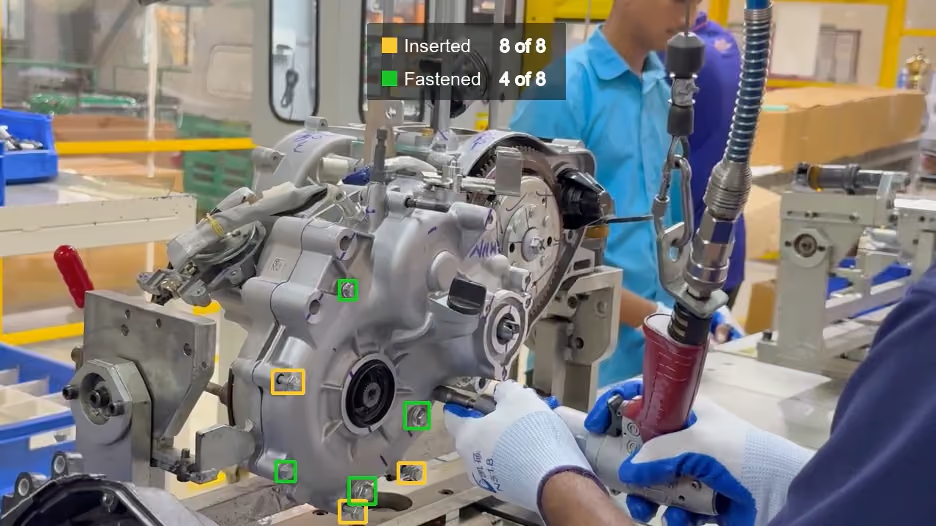
In poka-yoke terms, that’s the contact method (is each bolt where it should be?) and the fixed-value method (are all eight in and tightened?) handled by one camera. The next step is the motion-step method: checking that the bolts are tightened in the required order.
What a camera can't do
A camera isn't the right answer for every station:
- It needs line of sight. If a step happens inside a housing or behind the operator's hands, the camera has to see it from another angle, or it won't see it at all.
- Lighting and camera position matter. Move the camera or change the lighting, and the system may need adjusting.
- Each product variant needs training data. The model learns from footage of the real process, so a new variant means new examples.
- It makes mistakes too. A model can miss a step or flag a correct one. Too many false alarms, and operators start ignoring it like any other warning light.
- It shouldn't replace good design. If a fixture can make an error impossible, use the fixture. A camera is for the errors that design alone can't prevent.
- It has to pay for itself. Training a model on your process and building the system around it is a real investment. If errors at a station are rare, or cheap when they slip through, simpler error proofing is the better deal.
How to choose the right poka-yoke for a station
Start with the error, not the device:
- Can the error be designed out? Change the part or fixture so it only fits one way.
- Is it one attribute that a simple sensor can check? Use a sensor or counter.
- Does it involve several parts, a sequence, or flexible components? That's where a camera earns its place.
- How much does one escaped defect cost? The higher the cost of a single error reaching the customer, the more it's worth verifying every step, not just the result.
Getting started
The practical way to test vision-based poka-yoke is on a single station, with the error that costs you the most. Record the process, define the steps, and check whether a camera can reliably confirm them before committing to a full rollout.
That's how we approach it at Codya: we start with a proof of concept on one station, using footage of your actual process, before anything gets installed on the line.
Have a manual assembly step where errors keep slipping through? Tell us about it.
FAQ
What are the three types of poka-yoke?
By method: contact, fixed-value, and motion-step. By function, poka-yoke is either control or warning.
What is a poka-yoke device?
Any physical or electronic mechanism that prevents or detects an error at the point where it happens. Examples include guide pins, sensors, part counters, pick-to-light systems, and cameras.
Is poka-yoke the same as error proofing?
Yes. Poka-yoke is the Japanese term; error proofing and mistake proofing are the English equivalents.
Can poka-yoke be automated?
Many poka-yoke devices are already automated: sensors, interlocks, counting tools. Camera-based systems go a step further by checking several conditions and the sequence of steps at once, without contact with the part.